Sales & quotations
Customers & vendors
Customers and vendors are kept in one register — Customers & Vendors. One company can be ticked as both a customer and a vendor; you never register it twice.
- Company details — name, registration number, TIN, SST number and a structured address.
- Several PICs (persons in charge) with phone, email and department. Mark one as the main PIC for sending documents.
- Commercial defaults — payment terms (used to calculate invoice due dates) and, for vendors, bank details for payment reference.
- Attachments such as registration certificates.
The list
Two cards at the top switch between Customers (opened first) and Vendors; View all shows both together.
- Most active first — customers are sorted by the value invoiced in the last 12 months, with a Not yet paid column; vendors by the value of approved POs in the last 12 months. Click a column heading to sort another way.
- Your favourites (star) are always at the top.
- Each company has a coloured letter icon — its short form in brackets, such as (DBP), or an acronym at the start of the name, such as TNB; otherwise the first letters of the first two words. Words like Sdn, Bhd and Berhad, and brackets such as (M) or (Asia), are ignored.
The customer page — everything in one place
Open a customer to see its key figures at the top: invoiced and received in the last 12 months, not yet paid, overdue (in red) and active work orders. Below them, tabs list all of the customer's RFx, quotations, work orders, invoices, DOs and payments, each with its status — the latest 25, with a link to the full list when there are more. Company details, addresses and PICs follow underneath.
RFx & bid decision
Register every request for quotation or tender you receive as an RFx — even ones you may not pursue. The list becomes your sales pipeline.
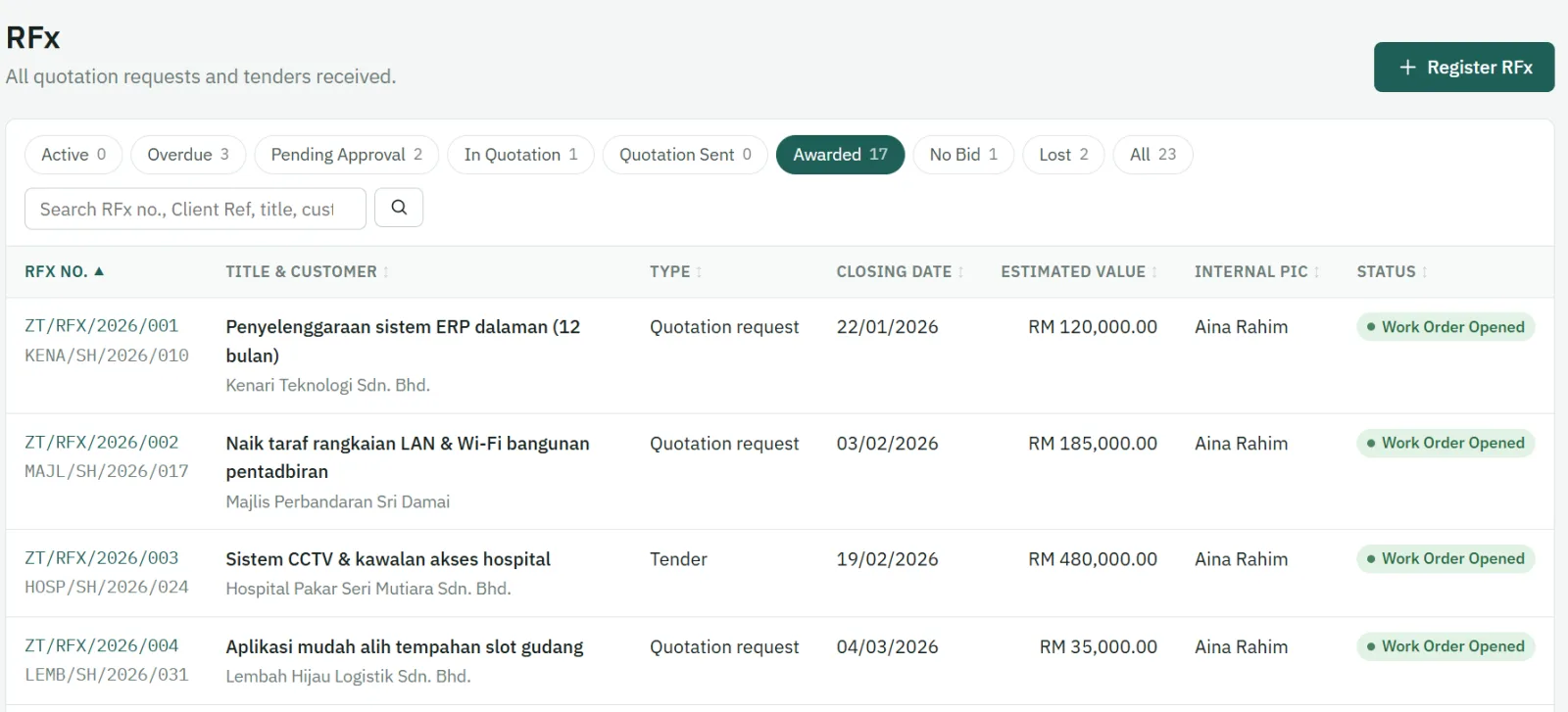
The list opens on Ongoing — RFx that are still moving: active ones, awarded ones, and those whose work order is still running (not closed or cancelled). Your starred RFx come first, then active RFx by nearest closing date, then awarded RFx (newest first). Once a work order has been opened, the status badge shows the work order's current status, for example WO Closed. The filters beside it show Active, Awarded, Overdue and each status on its own; All shows everything. Searching from the list always searches all RFx.
Creating an RFx
- Choose the type (quotation, tender or other), customer and customer PIC. The RFx number is generated automatically.
- Enter the title, closing date, your company PIC and the approver who decides whether to bid.
- Optionally enter an estimated value (used in the pipeline report) and attach the customer's documents.
- Click Submit for decision.
Bid / No-Bid
The approver is notified and decides:
- Bid — the RFx moves to In Quotation and Procurement can start the costing sheet.
- No-Bid — the approver must choose a reason (out of scope, price not competitive, capacity full, not enough time, other). The RFx is closed but stays in the records for reporting.
Your admin can set a Sales bid limit: RFx with an estimated value up to that amount may be decided by Sales without an approver. When the limit is 0, every RFx needs an approver.
RFx statuses
| Status | Meaning |
|---|---|
| Draft | Sales is still filling in the RFx. |
| Pending decision | Submitted to the approver for Bid / No-Bid. |
| No bid | Not pursued (final). |
| In quotation | Approved to bid; costing and quotation in progress. |
| Quotation sent | Set automatically when the approved quotation is marked as sent. |
| Awarded | The customer chose you. |
| Lost | The customer chose someone else (final, with a reason). Optionally record the winning competitor and their winning price — used to answer "why did we lose?" and "who beats us most often?". |
| Cancelled | The customer cancelled the request (final). |
| Work order opened | Set automatically when the work order is created. |
Costing sheet & supplier quotations
Costing sheet
Each RFx being quoted has one costing sheet. For every item enter the quantity, unit, cost per unit and markup %, and choose its source — in-house or a supplier.
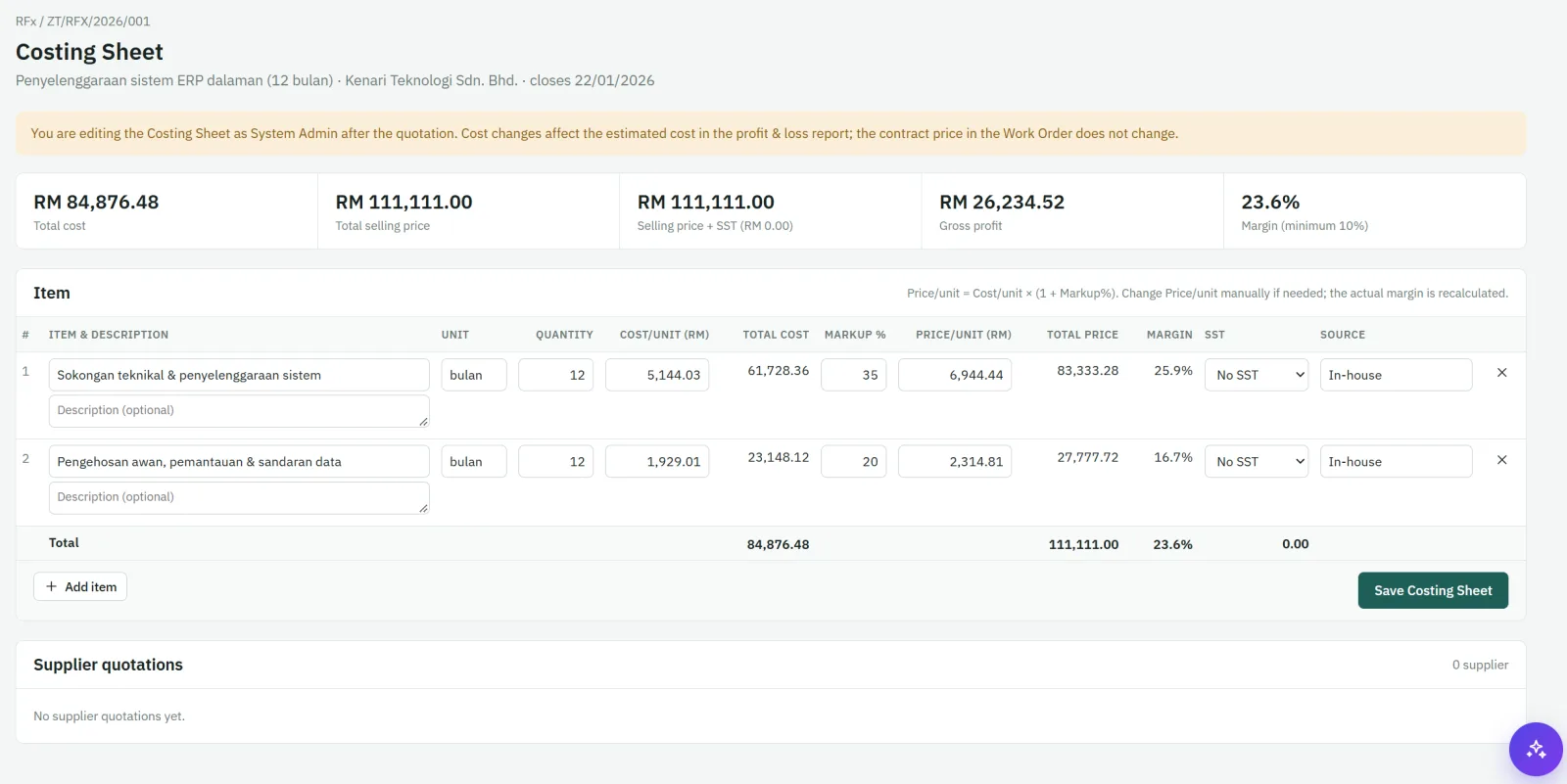
- Total cost = quantity × cost per unit
- Unit price = cost per unit × (1 + markup % ÷ 100)
- Line total = quantity × unit price
You may type a unit price manually. The sheet then shows the real margin and warns you if it is negative or below the minimum margin set in Parameter Setup. The summary at the top shows total cost, total selling price, gross profit and margin %.
Items tagged to a supplier are later used to create purchase orders for that supplier.
Supplier quotations
Drag and drop the quotations you receive from suppliers (PDF, Excel or images) onto the job. Approvers can open them as reference when approving purchase orders.
Quotations
Create a quotation from an RFx that is In quotation. Items, quantities and unit prices come straight from the costing sheet.
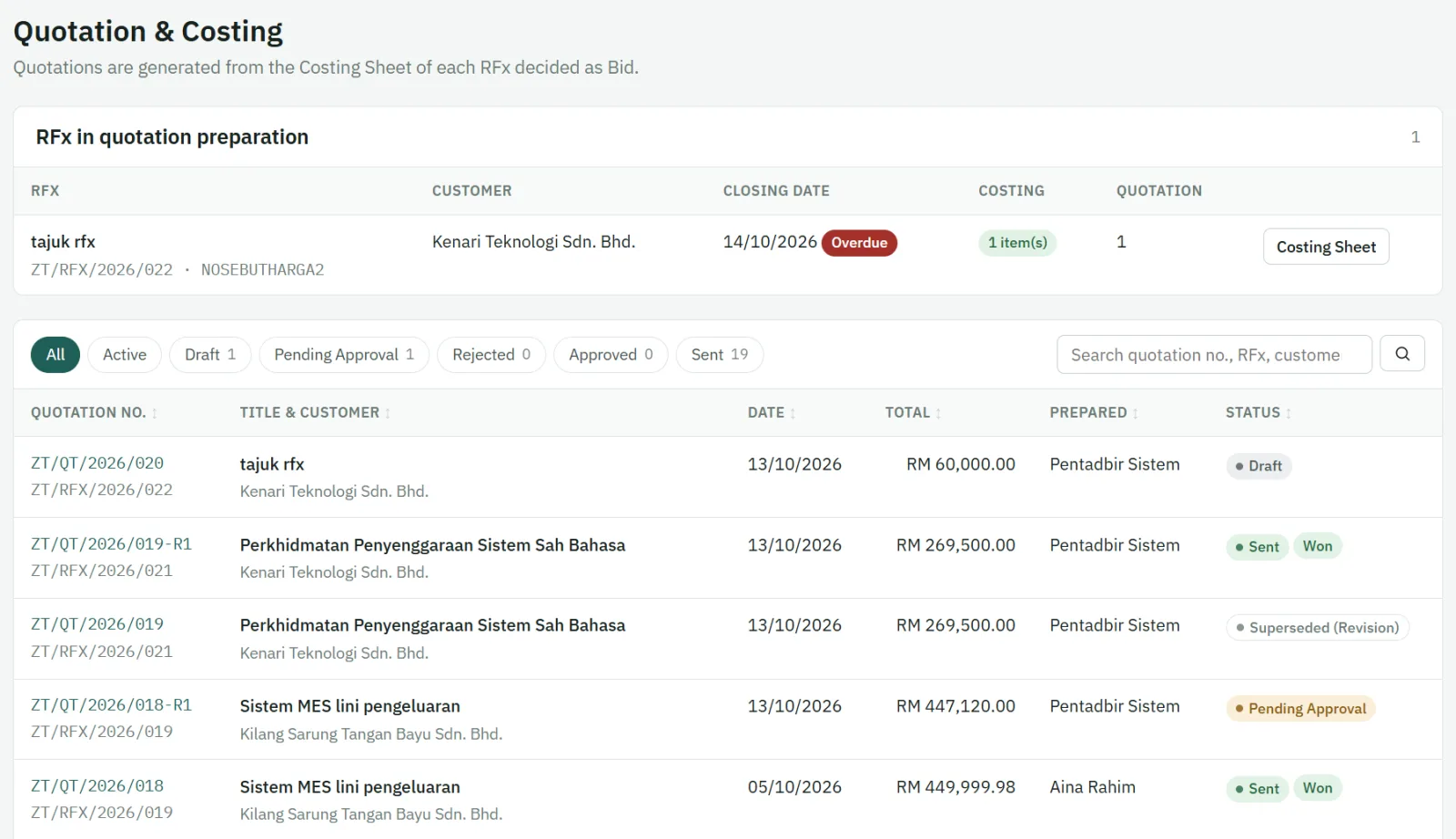
- Add discount (if any), SST per item, validity date and payment terms. Default notes are filled in from Parameter Setup and can be edited.
- Submit for approval. Once approved, the quotation is locked; download the PDF or email it to the customer's PIC and mark it as sent.
- Need to change price or scope? Create a revision (for example …-R1). The previous version is kept and marked Superseded.
- When the RFx is Awarded, choose which quotation version the customer accepted — the work order is linked to it.
Statuses: Draft → Pending approval → Approved → Sent (or Rejected, Superseded, Cancelled).